Cellbes delivers exchanges in 48 hours – here’s how
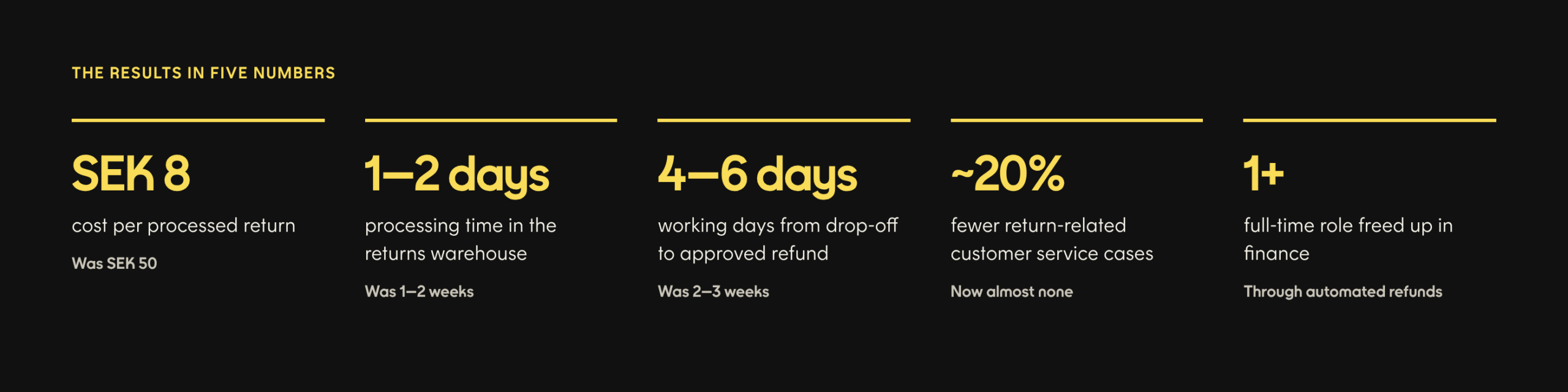
Stadium, the Nordic sports retailer, cut the cost of handling an online return by more than 80 percent. Customers now get their money back in days instead of weeks. Here is how they did it, step by step, told by Kristian Jönsson, Supply Chain Developer and Application Specialist at Stadium.
WHERE THEY STARTED
Stadium comes from physical retail, where returns are a small share of sales. As online sales grew, so did returns. During campaign peaks the returns team could not keep up. Customers waited weeks for their money, and customer service, already busy with outbound orders, took the calls.
What pushed them to act
What made it worse
“The customers weren’t happy, we weren’t happy.”
Kristian Jönsson, Stadium
HOW THEY DID IT
Stadium did not change everything at once. They built the case, gave returns an owner and moved step by step. Each step solved one problem and made the next one easier.
1. Build the business case and give returns an owner
A business analyst was asked to map what returns really cost and how they affected customers, making the cost of doing nothing visible. The analysis looked at customer satisfaction, lead time, customer service workload, return processing cost, manual work in finance, tied-up inventory, markdowns and the growing cost of online returns. Supply chain and customer service then took ownership, with more departments joining over time.
Why it matters: You do not need a perfect forecast. Once the cost of doing nothing is on the table, the case for change becomes clear. Returns touch many departments but often belong to none, so someone has to own them first.
2. Make the customer’s return digital
No more pre-printed return label and paper form in every parcel. Customers register their return online. A few needed help at first, and within a short time it was a non-issue.
What it saved: Printing and packing labels and forms in every order. The warehouse now knows what is coming before it arrives: how many returns tomorrow, and the day after.
3. Set up return rules and return codes
Every return gets a return reason, and every check in the warehouse has a code, such as missing packaging or a product defect. Clear rules then decide what happens next: approve automatically, route a deviation into a separate flow, or send a case to customer service.
What it gave: Control of the flow and data on why products come back. The same codes feed product improvements and claims to suppliers, and the rules are refined as the data grows.
4. Guide the warehouse with a screen, not paper
Staff in the returns warehouse work in a guided interface. It shows a picture of the product, tells them what to check and where the item goes next: back to stock, or to a partner that gives damaged products a second life.
What it saved: Faster handling and fewer mistakes. New staff can step in and work right away. Productivity has gone up every year since.
“When everything is manual, it’s really hard to bring in a new staff member. Now a new worker can just step in.”
5. Automate refunds
When a return is approved, the refund goes out automatically. With Swish, the customer has the money right away.
What it saved: Finance freed up more than one full-time role. Customers stopped calling to ask where their money was.
“Today we receive almost no return-related questions. The one question we still get is where to register the return.”
6. Put the same tool in every store
Stores still make up most of Stadium’s sales, and many online customers return in store. Store staff now handle online returns in the same interface as the warehouse, and register the return for customers who did not do it online.
What it gave: Return reasons and data on every online return, wherever it is handed in. Next up is a deeper integration in Stadium’s new store tills.
7. Handle Norwegian (outside the EU) returns locally
Norway is outside the EU, so every return sent back to the Swedish warehouse would cross a customs border. Online returns from Norway are handled in Norway, with a Stadium Outlet store acting as the online returns hub. Every item in Outlet’s online range is also sold in that store, so returns go straight back on sale there. Returns from Finland, inside the EU, go to Sweden.
What it saves: No customs handling and no long cross-border transport for each Norwegian return, and the item is back on sale in the market where it was bought.

Today we receive almost no return-related questions
Kristian Jönsson, Supply Chain Development Manager
AT THE SAME TIME
Many retailers put returns on hold until a new ERP or platform is in place. Don’t let a major system change become a reason to wait. Returns kept running through all of it.
THE SMALL THINGS
Big moves get the headlines. Many of the savings come from details that are repeated thousands of times a year.
THE CUSTOMER’S SIDE
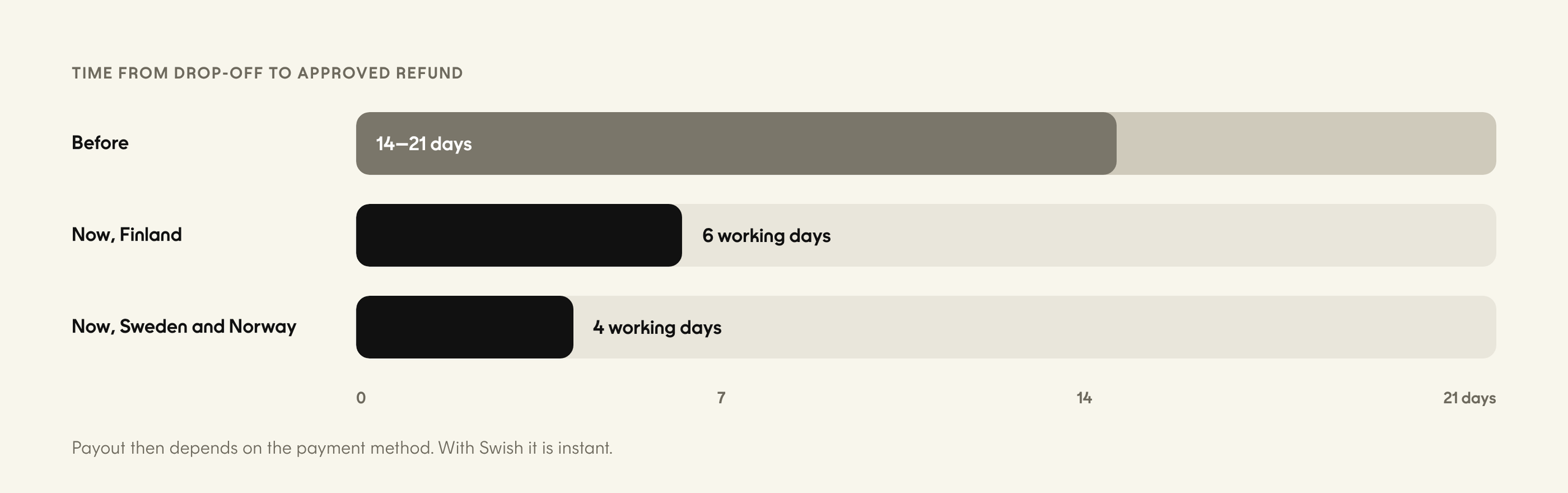
Before, slow handling in the warehouse and manual work in finance added up, and the whole process took 14 to 21 days. Today it takes four working days in Sweden and Norway from drop-off to an approved refund. Finland takes six, since returns travel to Sweden. With Swish, the money arrives right away.
BEYOND COST
WHAT’S NEXT
“The first part of our journey was mainly about digitalisation, efficiency and collecting data and insights. The next part is increasingly about optimisation, profitability and circularity.”
Kristian Jönsson, Stadium
KRISTIAN’S ADVICE
“We postponed it more than once. Now we wish we had started earlier.”