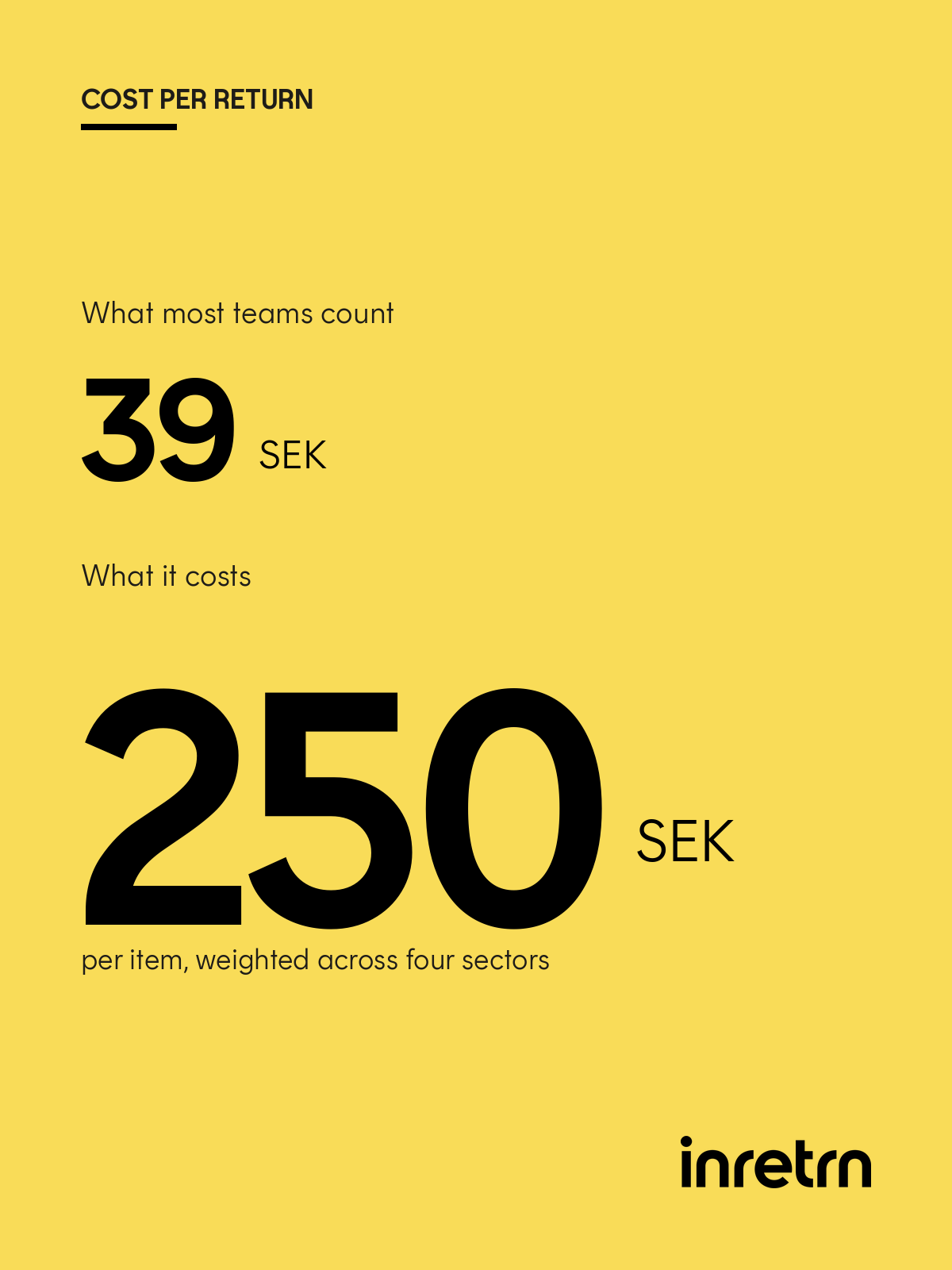
The 4 costs missing from your cost per return
The 4 costs missing from your cost per return Most returns business cases lose internally because the number at the top is too low. Here is where the missing money sits, where the data lives ...
From June 19, 2026, ecommerce businesses selling to consumers in the EU must comply with a new legal requirement: the withdrawal button.
In short, consumers must be able to withdraw from a purchase online with one click – just as easily as they placed the order.
No email.
No customer service interaction.
No friction.
This is not a UX trend. It’s a legal obligation.
And many ecommerce setups are not prepared.
The withdrawal button is a digital function that allows consumers to exercise their right of withdrawal directly on the website.
The requirement is based on EU consumer protection law and becomes mandatory in June 2026.
To be compliant, the withdrawal button must be:
Most importantly:
👉 Withdrawal is not the same as a return.
This is where many ecommerce businesses run into trouble.
In many systems today, withdrawal and returns are handled as the same flow. Same rules. Same conditions. Same processes.
Legally and operationally, that is incorrect.
Withdrawal is a statutory consumer right.
Returns are a commercial policy.
They differ in:
Mixing them creates:
And once the withdrawal button becomes mandatory, these weaknesses become visible very quickly.
Adding a withdrawal button to the interface is not enough.
To truly comply, ecommerce businesses must be able to:
In other words:
The withdrawal button is a post-purchase operations challenge.
In Inretrn, withdrawal is handled as its own function – completely separate from returns.
This means that the right of withdrawal:
In practice, this allows ecommerce businesses to:
Everything is rule-based.
Everything is automated.
Everything is built to scale.
As a result:
In short:
Inretrn is already fully aligned with the withdrawal button requirement in ecommerce.
The withdrawal button is more than a compliance checkbox. It is one of the first EU regulations that actively removes friction from the post-purchase journey.
That forces ecommerce businesses to rethink:
The companies that succeed here won’t just be compliant.
They will have:
For many ecommerce teams, preparing for the withdrawal button means:
This is not something to solve in the last quarter before the law takes effect. The earlier you address it, the smoother the transition will be. Because this is not the end of conversion optimisation.
It’s the end of shortcuts.
For most rules, enforcement falls under the authority of the country where your business is based. However, if a specific country has stricter requirements, a consumer in that country can approach their local authority. Our recommendation: use the most stringent market as your baseline. The EU directive is harmonized in its core rules, but implementations vary in enforcement culture and local nuances. Germany tends to require the most careful handling. Configure one set of core compliance rules in inretrn, and localise communication – language, terminology, model form language – per market.
Germany has one of the most consumer-protective legal environments in the EU and one of the most active. Consumer organisations and authorities act quickly, and Germany has a strong tradition of abmahnung: formal legal warnings sent by competitors or consumer organisations for non-compliant withdrawal notices. Importantly, if you receive a formal demand from a German party, you must respond – failure to do so can escalate to legal proceedings. Your withdrawal information must be correct, complete, and use the approved model form language. We recommend your legal team reviews your withdrawal notice text for the German market specifically.
The consumer has 14 days from the withdrawal notice to return the goods. If they do not return them within that window, you are no longer obligated to refund. You can hold the refund until goods are returned or proof of return is provided. If goods are not returned at all, the withdrawal is effectively invalidated – the customer loses their refund entitlement.
An order confirmation email alone is not sufficient. The requirement is for a button or hyperlink on your website – clearly visible, available to every customer including those not logged in, at any point within the 14-day window. An email link that expires or becomes unreachable does not meet the legal standard. The function must be on-site and easy to find.
We recommend keeping the withdrawal period at the legal length of 14 days because you don´t want to take the risk of being obligated to refund the outbound shipping cost longer than necessary. Your returns policy can be as generous as you like, and you can set your own conditions on those. The key is to make sure the two flows – withdrawal and returns – are clearly separated and work seamlessly together. Inretrn supports per-segment window configuration if you do choose to extend for specific customer groups.
Freight options can be pre-configured per market (merchant decides the return method), based on the outbound freight option used – making home pickup the natural return method for home deliveries – or offered dynamically to the consumer during the withdrawal flow. The setup depends on your carrier contracts and markets, and is configured per merchant.
Withdrawal (“angeratt”) and returns are two separate flows and should be handled as such. The withdrawal function is a new, additional requirement on top of your existing return flow. Our recommendation: continue running your current returns process, and add the withdrawal function as a separate, dedicated flow alongside it. Ideally, both are digitised and work seamlessly together. Inretrn is built to handle both flows in parallel.
Requiring an order number together with an email address is acceptable – some form of identification is necessary to locate the contract. The directive requires that exercising the right of withdrawal be no more difficult than entering the contract, so you need to ensure there is a workable fallback if a customer cannot locate their order by email.
The communication must explicitly say “withdrawal” (“angra ditt kop” / “angeratt”). A withdrawal is its own legal act – separate from a regular return – and conflating them in a single email creates ambiguity that can work against you. Inretrn sends separate, clearly labeled communications for withdrawal flows.
The return cost must be written out clearly in your terms and conditions. As long as it is clearly stated there, you can refer to it – a volume-based fee structure is acceptable if it is explained. What you cannot do is hide the existence of a return cost or leave it ambiguous. If your fee varies by order size, state that clearly in your terms before the customer completes the purchase.
The 4 costs missing from your cost per return Most returns business cases lose internally because the number at the top is too low. Here is where the missing money sits, where the data lives ...
You asked. We answered. Everything from the Withdrawal Webinar Q&A - in one place. Book a walkthrough ...

Post-purchase experience refers to everything that happens after a customer receives a product. In ecommerce, this stage includes interactions such as returns, exchanges, refunds, warranty cl...