The best returns experience generates no tickets at all
The best returns experience generates no tickets at all Every team we speak to says the saving is customer service time. Almost nobody has counted it, and almost everybody is measuring the ...
A customer wants a medium instead of a large. Simple enough.
Here is what makes it hard. To say yes, you have to promise them the medium while the large is still in their hallway. If your system cannot reserve it, you cannot promise it, and the customer ends up chasing you instead.
One brand we spoke to turned exchanges off completely. The replacement was never reserved, the return took too long, and between the customer service load and the disappointed customers, switching the feature off was the better option.
That is worth sitting with. They had exchanges. Turning them off was an improvement.
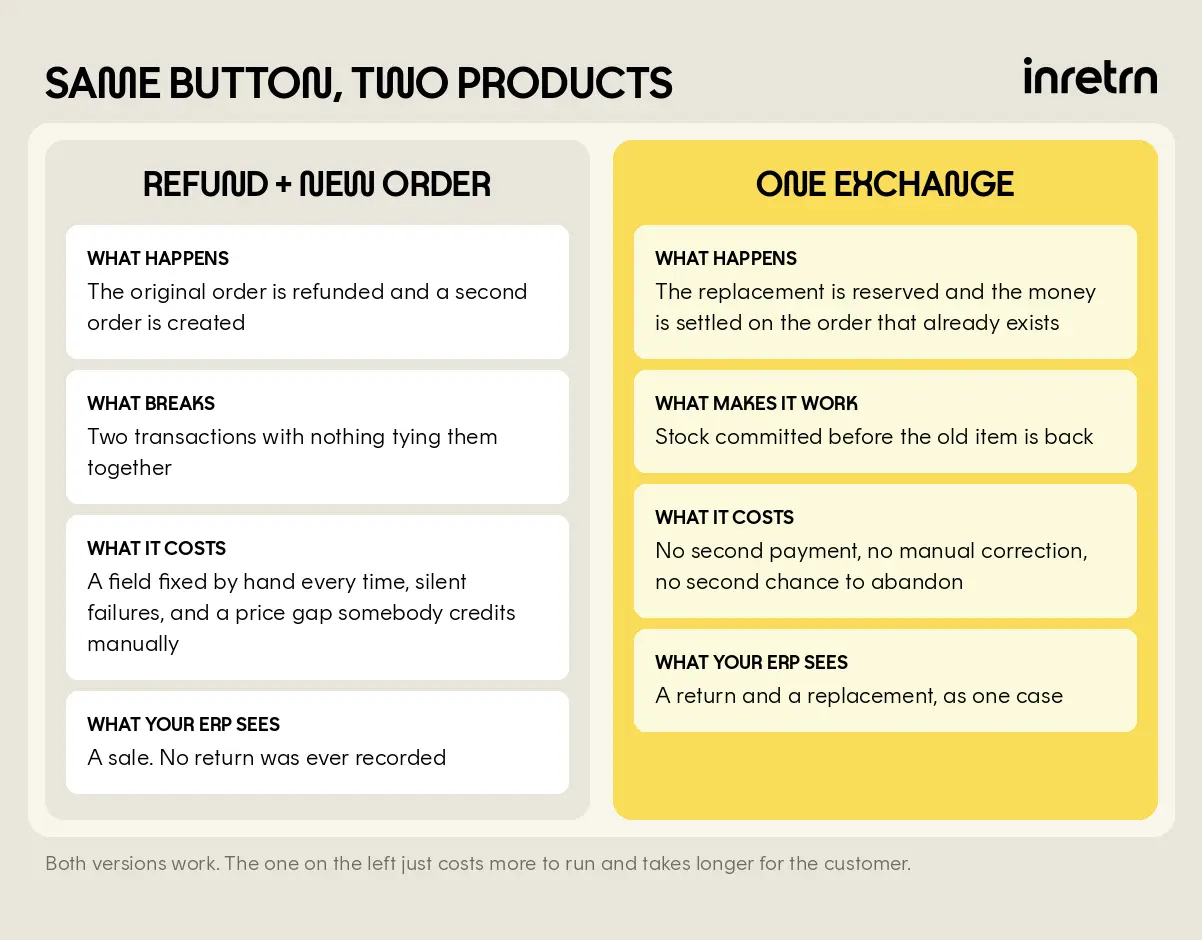
That is the difference between the two things this word covers. In the first, the exchange is a refund and a new order held together by hand. In the second, nothing is refunded and nothing new is created.
And the reason the second one holds together is that nothing in it is held together by a person. The commerce platform, the warehouse and the ERP are all told the same thing at the same time, so nothing has to be reconciled afterwards. That is the whole difference: one is a workflow somebody maintains, the other is a decision the systems make.
If you already know your exchange reserves stock before the old item is back, you have the second version. Skip to where the value stops, which is the part most vendors will not tell you.
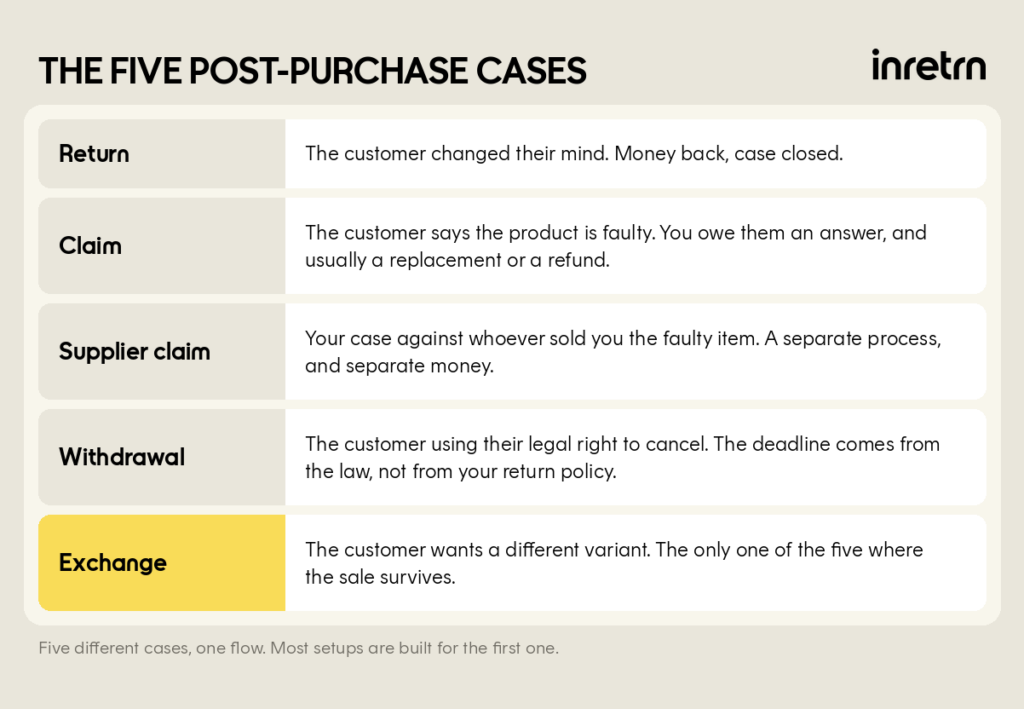
Let me define this properly, because the word has been stretched to cover things that behave nothing alike.
A return ends with you. The customer sends the item back, you send the money back, and the transaction closes. One party, one decision.
A claim is the customer telling you something is wrong with the product. You owe them an answer, and often a replacement or a refund, and that part does end with you. What does not end with you is getting the money back from whoever supplied it, which is a separate process against the supplier and the reason claims tend to sit in a mailbox.
An exchange is the only one of the three where the sale survives. And it is the only one where the decision chain has to run before the item is back, because you are promising someone a medium while the large is still in the post.
That last sentence is the entire reason exchanges are hard to build, and the reason so many products stop just short of doing it properly.
So why does any of this matter to you? Because the most common return reason in apparel is size and fit, by a wide margin. Which means the largest single category of returns you have is not people changing their minds. It is people telling you precisely what they wanted instead.
Every one of those that ends in a refund is a sale you gave back on request
None of these announces itself. That is what makes them worth naming.
Each one comes from an actual conversation with a company that had an exchange feature and was not getting anything out of it.
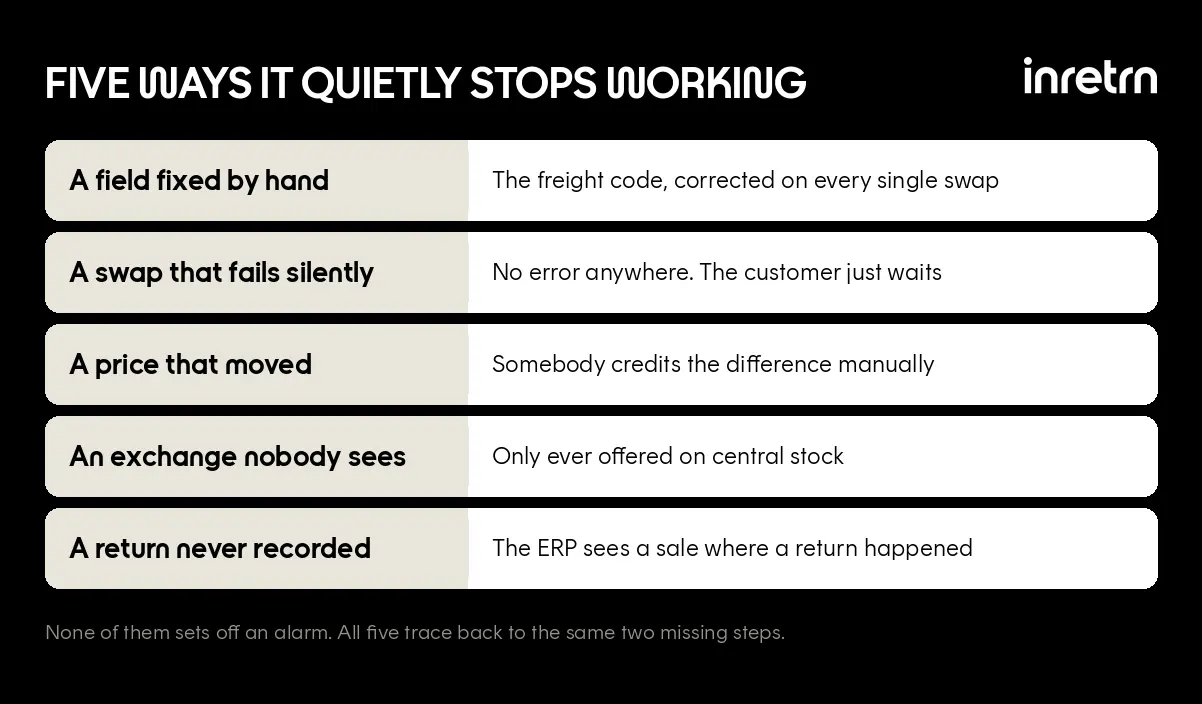
What it looks like from the inside: somebody on your team updates a field by hand on every single exchange. In one case it was the freight code, which does not carry across when the new order gets created, so a person opens each one and fixes it. Every one, not occasionally.
Why it happens: the new order was not created by your commerce platform in the normal way, so it arrives without the things a normal order carries.
What it is costing you: forty seconds per exchange, times your volume, spent on a task nobody has named or budgeted. And it scales linearly, which is the opposite of what you want.
What it looks like from the inside: sometimes the replacement order just does not get created. Nobody gets an error. The customer waits for something that is not coming, then gets in touch to ask where it is.
Why it happens: two systems, two transactions, and no single case tying them together. If the second half fails, the first half has already happened.
What it is costing you: a support ticket, a disappointed customer, and a refund you now have to issue anyway.
What it looks like from the inside: the customer returns the item, orders the new one, notices the price changed between the two, and contacts you. Somebody credits the difference by hand.
A customer care lead described this to us and then asked the question that makes the whole thing land: how often does the thing you order online fit on the first go?
Why it happens: two transactions at two moments means two prices. There is no mechanism to net the difference, because there is no single order to net it against.
What it is costing you: a contact on a meaningful share of your largest return category, plus a second card fee, plus a second chance for the customer to abandon.
What it looks like from the inside: conversion is low and nobody knows why, so the assumption becomes that customers do not want exchanges.
Why it happens: the exchange can only be offered on items sitting in central stock at that exact moment. Out of stock, on backorder, or available in a shop, and the customer is quietly shown a refund instead.
What it is costing you: everything. One prospect told us they abandoned an entire platform over this. The feature was there. Their customers never saw it.
What it looks like from the inside: your ERP shows a sale where a return actually happened. One head of ecommerce described it to us exactly that way: it works as a new order every time, and when the return happens the ERP does not know anything about it.
Why it happens: if the exchange is a refund plus a new sale, there is no return order in the middle for anything to attach to. And with no return order there is nothing to reserve the replacement against either, which is why the stock question and the reporting question turn out to be the same question.
What it is costing you: your return rate is understated, and so is every cost figure built on it. Which is awkward, because the business case for fixing this is normally built from exactly those numbers.
And one more thing worth mentioning, because it is a revenue line that simply does not exist in most setups: moving to a more expensive variant needs a payment taken mid-flow, and many systems cannot take one. So the customer can be offered a downgrade or a refund. Never an upgrade.
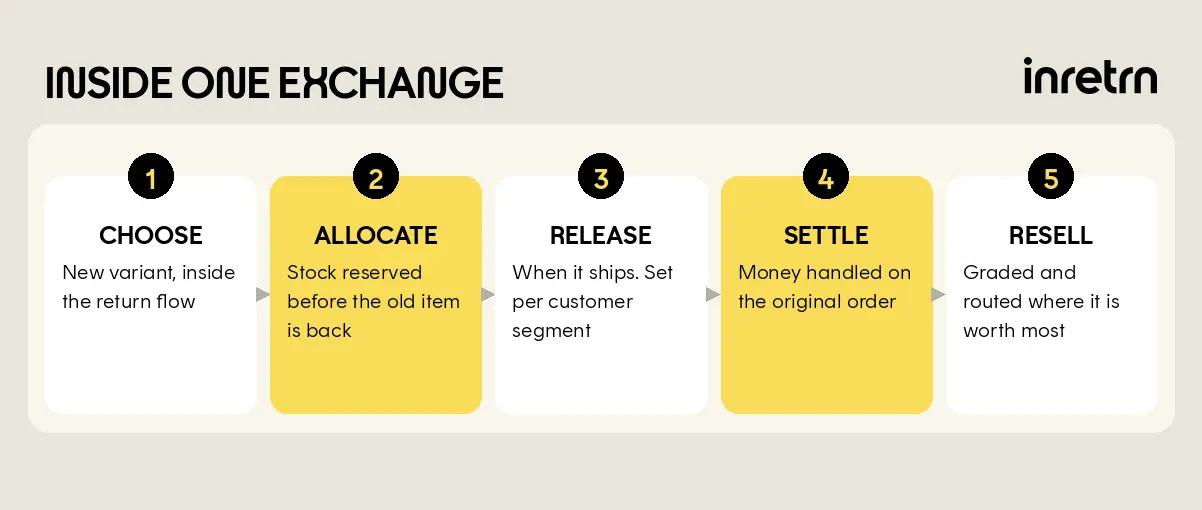
Five decisions, and the customer sees none of them. Here they are without the jargon.
1. They pick the new one inside the return flow. Not in a fresh basket, not after a refund lands. They are already telling you they want a medium. The only question is whether your flow lets them say it there and then.
2. You promise them stock you do not have back yet. This is the hard one. The medium gets reserved for that customer the moment they choose it, before the large has left their house. Everything else on this list is straightforward by comparison.
3. You decide when to actually send it. Immediately, when the carrier first scans the parcel, or only once the old one has been inspected. And you should be able to set that differently for different customers, because a first-time buyer and someone with eleven orders behind them do not need the same treatment.
4. You settle the money on the original order. No credit note, no second card payment. If the medium costs 200 more, that difference is handled inside the transaction that already exists.
5. You decide what happens to the old one. Graded when it arrives and sent wherever it is worth most, which is not automatically the central warehouse.
Steps two and four are the whole difference. Reserving and settling. Every one of the five failures above traces back to one of them, which is oddly good news: it means this is one problem, not five.
We can see this across our own customers, and the spread is wide enough to be worth explaining.
A single-brand fashion retailer turns 28.6 percent of return requests into exchanges. A single-brand outdoor brand turns 23.7 percent. A multibrand sports retailer turns 10.8 percent.
All three run the same platform, which tells you something useful: the software is not what creates the difference between 10 and 29 percent.
So what does? Three things, and you can assess all of them about yourself in a few minutes.
Whether you are one brand or many. If a customer came for your brand, a different size of your product is a perfectly good outcome. If they came to compare twelve brands, the refund is just part of shopping around.
How much they wanted this specific thing, as opposed to something in this category.
Whether they expect to buy from you again anyway. Loyalty makes people patient.
Which means you can work out your own ceiling before committing to anything. One brand, with real depth in the sizes people actually want: aim high. Multibrand marketplace: expect the lower end, and it is still very much worth having.
One note on the starting point, because if you are replacing something you have probably been told to distrust any figure calculated from zero. That is usually fair advice. But if your current setup does not reserve stock, your baseline genuinely is close to zero, because what you have today is a refund and a hope. So these numbers are the uplift, not a flattering way of counting.
Here is how to check that in about a minute. Take your largest return reason. If it is size or fit, find out what share of those customers placed another order within thirty days. Whatever that number is, that is what you are converting today, entirely by accident.
Six lines, and only the first one is revenue.
Revenue. The sale is kept instead of reversed. You still carry the freight and the handling on the swap, so this is not free, but you keep the revenue and the gross margin on the item rather than writing off both. And be precise about what you are comparing against: the alternative is a refund, not a hypothetical new order at some point later.
Payment cost. The original payment is referenced rather than reversed, so there is no second transaction fee and no refund fee.
Logistics cost. The carrier gets chosen inside the return flow, and if the item can go to a store or a hub it may never travel back to central at all.
Operating cost. Rules make the decisions instead of people, so volume grows without adding headcount. Across our customers that shows up as roughly 80 percent fewer return-related support tickets and 67 percent more capacity from the same team.
Margin control. Price differences get netted inside the basket, and variants can be gated by rule. The margin you expected at checkout is the margin you keep.
Working capital. The item is sellable again sooner, which means less markdown and less cash sitting in parcels in transit.
More revenue kept, at a lower cost per case. Most operational improvements trade one against the other, so it is worth pausing on the fact that this one does not.
This runs against every sales instinct, so let me be blunt about it: the exchange should not appear every time.
The return reason, the product category and the stock position should all get a vote on whether it is even shown.
If the item is faulty, an exchange is the wrong offer. That is a claim, and it behaves differently.
If the product is deep in markdown, a swap can quietly cost you margin rather than protect it.
And if the replacement genuinely is not available, showing it and then failing is worse than a clean refund. You end up with a disappointed customer, a support ticket, and a return you still have to process. Three costs where you could have had one.
So the version that works is a set of rules rather than a switch. More work to set up, considerably better to live with.
There are three ways to run this, and we actively tell people to avoid one of them.
Online exchange. Swap the size, shipped from the online warehouse. Simple, and for plenty of companies completely sufficient.
Return in store, fulfil from the warehouse. The sweet spot for most people. The customer gets the convenience of dropping it off locally, you keep the operational simplicity of shipping from one place. Almost all of the value, a fraction of the complexity.
Swap against that specific shop’s stock. Overrated, honestly. A little extra value, a lot of store operations, and a pile of edge cases your staff have to carry around in their heads.
More omnichannel is not automatically more value. The third option is where the cost curve starts rising faster than the return curve, and we would rather tell you that now than after you have paid for it.
Three questions. The first one takes a minute and decides how much the rest of this matters to you.
If question one comes back as yes, that is worth a conversation. Not a demo. The gap between what you convert today and what you could convert is calculable from data you already have, and in our experience it is the largest single number in the business case.
We will build that calculation with you before anybody signs anything. If it does not hold up, you have learned something useful for free.
Next: what your suppliers owe you, and why almost nobody collects it.
Jennie Gerum CMO, inretrn
The best returns experience generates no tickets at all Every team we speak to says the saving is customer service time. Almost nobody has counted it, and almost everybody is measuring the ...
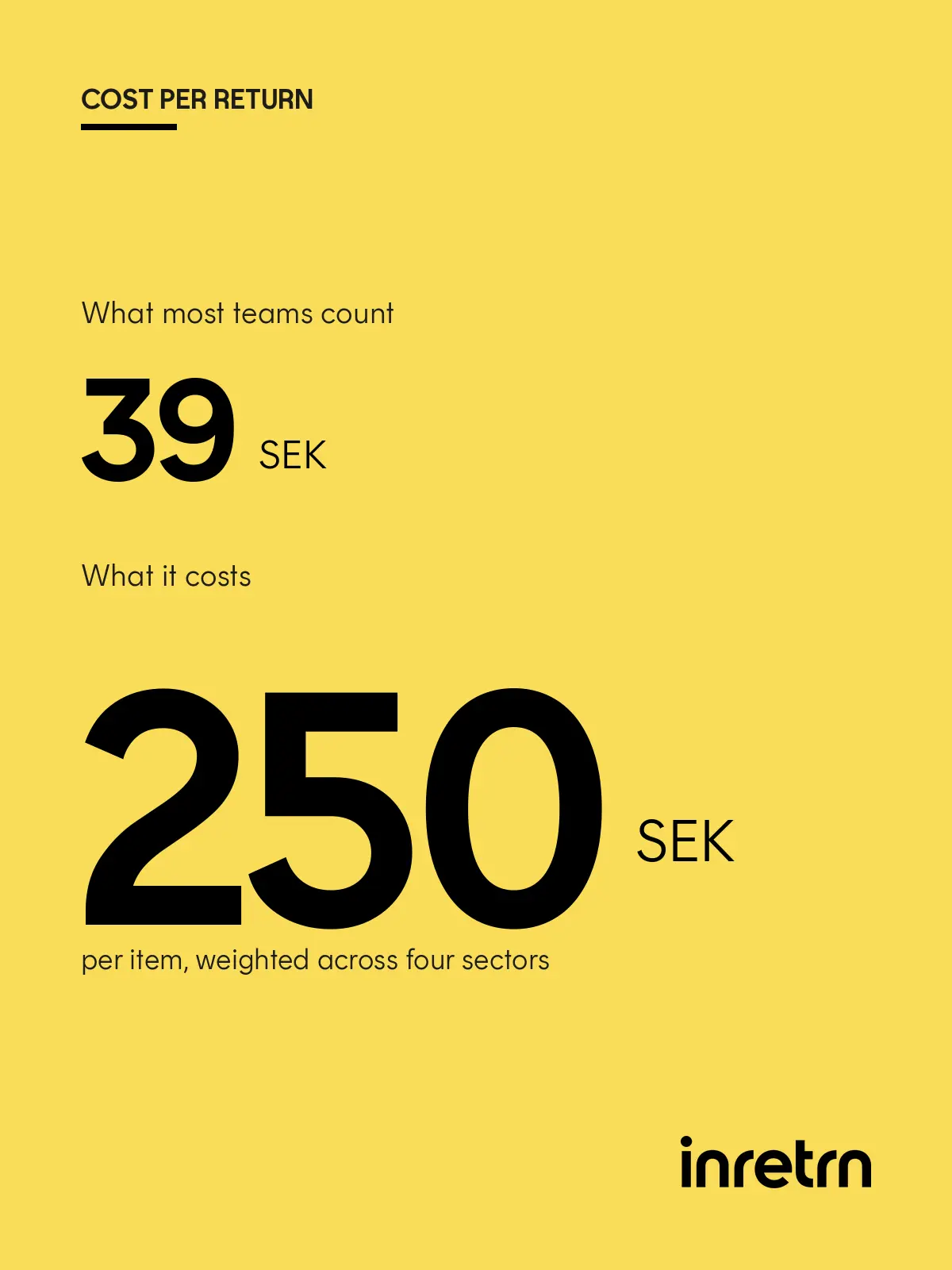
The 4 costs missing from your cost per return Most returns business cases lose internally because the number at the top is too low. Here is where the missing money sits, where the data lives ...
You asked. We answered. Everything from the Withdrawal Webinar Q&A - in one place. Book a walkthrough ...